
This blog post was provided by Resources Needed for Independence, Inc (RNFI), a Cohort 6 Grantee. RNFI is a North Carolina nonprofit dedicated to making independent living attainable and accessible for people with disabilities, older adults, and their caregivers.
“I could use this to help my dad. I didn’t know Alexa could do that.”
That reaction came from an attendee at a recent open house hosted by Resources Needed for Independence (RNFI). The attendee had just watched a demonstration where opening the front door automatically triggered a personalized video message on the television.
It captured something we believe strongly: sometimes the biggest barrier to using technology isn’t the technology itself. It’s simply not knowing what’s possible with devices already in our homes.
Seeing the Possibilities Firsthand
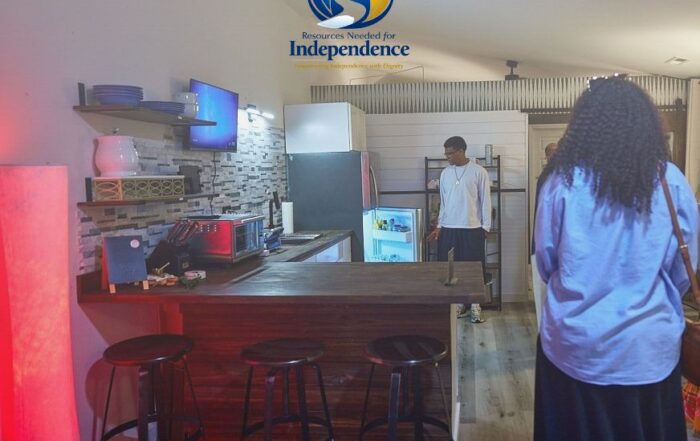
At Pebblebrook Living and Learning Center in North Carolina, caregivers toured a demonstration home where everyday technology was integrated into real-life routines.
Rather than sitting through presentations about technology, visitors experienced it working in a familiar living environment.
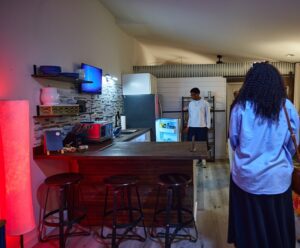
One demonstration showed how a door sensor could trigger an Alexa announcement or personalized video when an exterior door opened. Another automatically lowered the television volume when calls came in from selected contacts.
These weren’t complicated concepts requiring expensive, specialized equipment. They were examples of how familiar devices could be configured to address everyday caregiving challenges.
For one attendee, the door demonstration sparked ideas about supporting her father, who lives alone in another state. She had used Alexa for music and shopping but hadn’t considered these other possibilities.
Another caregiver shared a familiar frustration. “One of the things that frustrates and worries me is not being able to get my mom to answer the phone when she is watching one of her shows.”
Seeing the television automation in action offered a practical possibility she hadn’t considered. Those moments were exactly what we hoped our open house would inspire.
Many caregivers already own smartphones, voice assistants, smart televisions, and connected devices. What they often lack is the opportunity to discover how those tools can make caregiving easier.
That’s why RNFI’s approach to digital confidence coaching is simple. We start with everyday challenges rather than lengthy courses or technical instructions. What does a caregiver repeatedly need to check, remember, or do? Could a familiar device help? What would it take to make that solution work at home?
Our Use–Adapt–Opt-Out framework also recognizes that technology isn’t always the answer. The goal is to find what works for each person, whether that means using technology, adapting it, or choosing a non-technical approach altogether.
Through our Everyday Tech for Independence programming, RNFI is expanding opportunities for older adults, people with disabilities, and caregivers to explore practical solutions through demonstrations, hands-on learning, and individualized coaching.
With support from Community Care Corps, we’re also building volunteer opportunities that help community members gain confidence using everyday technology to support independence and ease caregiving demands.
Our open house reinforced an important lesson: people don’t always need more technology. Sometimes they just need someone to show them what the technology they already have can do.